Getting from Bozeman Airport to Big Sky: Every Option Explained
By Bozeman Proper Staff
February 12, 2026 · 9 min read
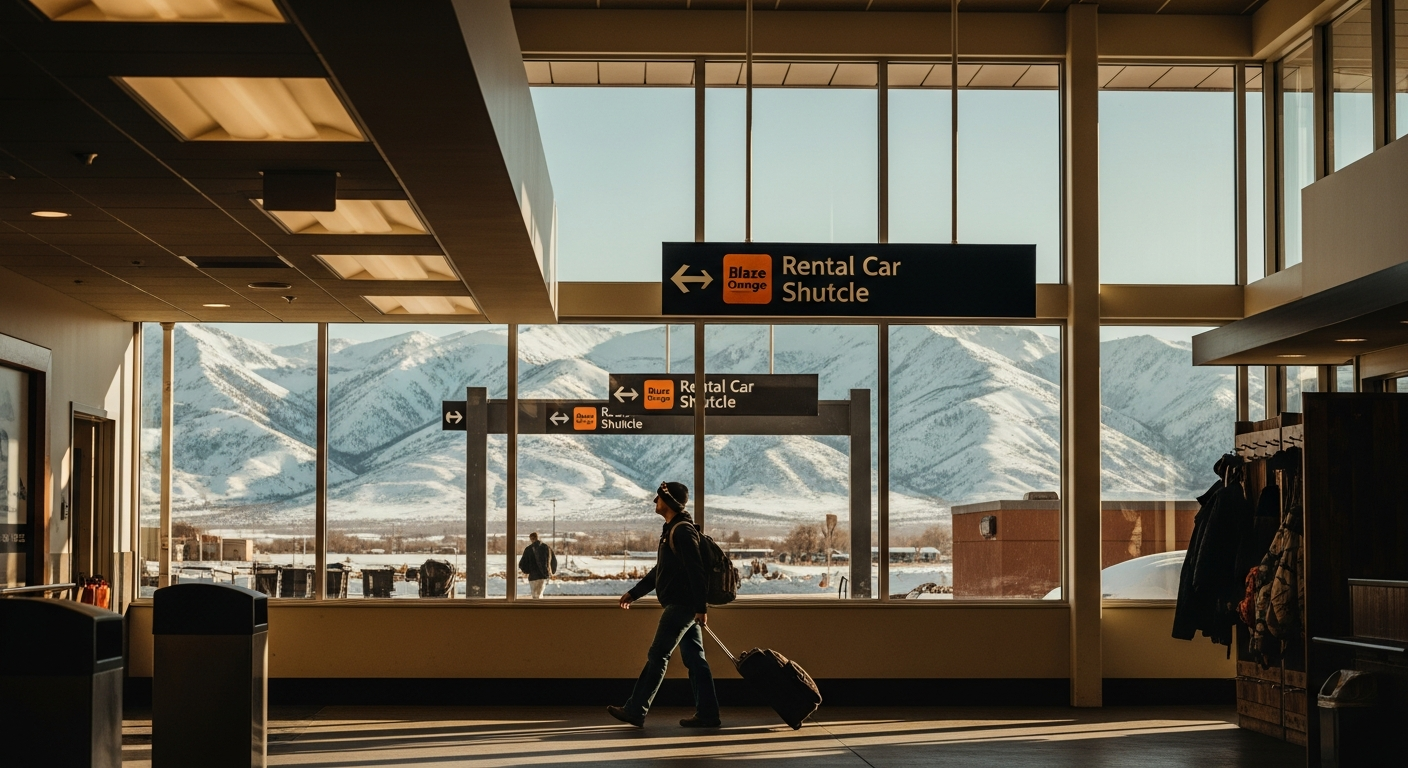
The distance from Bozeman Yellowstone International Airport (BZN) to Big Sky Resort is about 50 miles. That sounds simple until you realize most of that drive is a two-lane highway threading through Gallatin Canyon, with no passing lanes, semi trucks, and (in winter) ice. In summer, it takes about an hour. In winter, with snow and slower traffic, it can stretch past 90 minutes. There’s no Uber waiting at the curb. There’s no light rail. Your options are a rental car, a scheduled shuttle, a private transfer, or convincing a friend to pick you up.
Each one has real trade-offs depending on your trip type, group size, and how much you care about having a vehicle once you’re at the resort.
Know BZN before you land
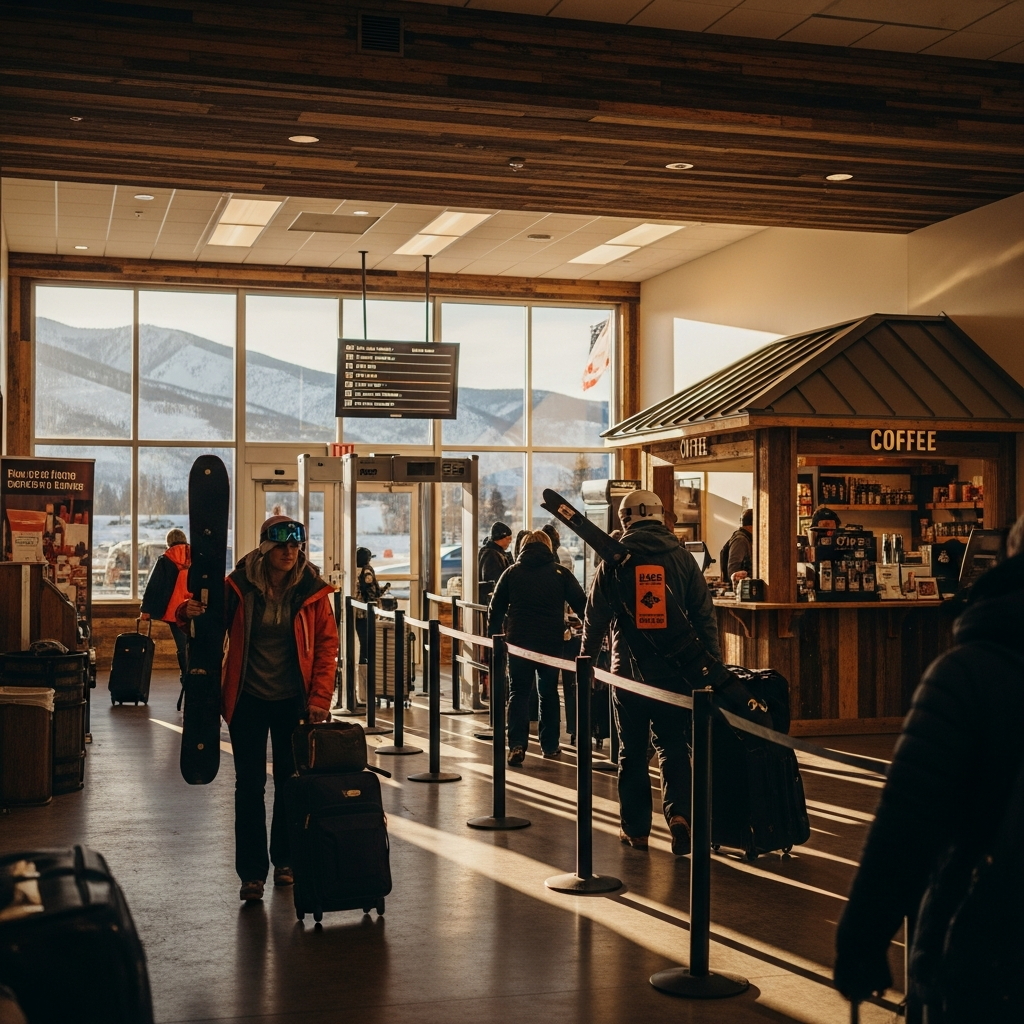
Bozeman Yellowstone International is a small airport. One terminal, one baggage claim area, one security checkpoint. You’re not going to get lost. After you clear the gate area, baggage claim is downstairs. All six rental car counters (Hertz, Avis, Budget, Enterprise, National, Alamo) are in a row on the ground level right next to baggage claim. No shuttle bus to a remote lot, no tram. Walk 30 feet and you’re at the counter.
The airport has free WiFi, a couple of food options, and a small general store if you need snacks for the drive. But there’s nothing to linger for. Once you’ve got your bags, you want to get moving — especially in winter when daylight is limited and you don’t want to be driving the canyon in the dark.
Rental car: the default choice
For most visitors, renting a car is the right call. You’ll want a vehicle at Big Sky anyway. The resort is not a self-contained village where you can walk everywhere, and having a car lets you access restaurants in Meadow Village, make grocery runs to Town Center, and take day trips to Yellowstone or back into Bozeman. If you’re deciding between staying in Bozeman versus up at the resort, a car makes either option work. If the same trip includes park time, read the BZN-to-Yellowstone transfer guide before you assume Big Sky and Yellowstone use the same transportation plan.
Book early for ski season. Inventory runs thin from late December through February, and walk-up rates can double. I’ve seen midsize SUVs go from $85/day online to $180/day at the counter during Christmas week. For a deeper breakdown on timing and pricing, check out our rental car tips.
Get an AWD or 4WD vehicle. This is not optional in winter. Gallatin Canyon (Highway 191) is plowed regularly but gets icy, and the road into Big Sky itself climbs in elevation. A Nissan Altima with all-season tires is a recipe for a bad day. Most airport agencies put snow tires on their fleet from November through April, but confirm at pickup. Ask specifically about tires, not just “is it winter-ready.”
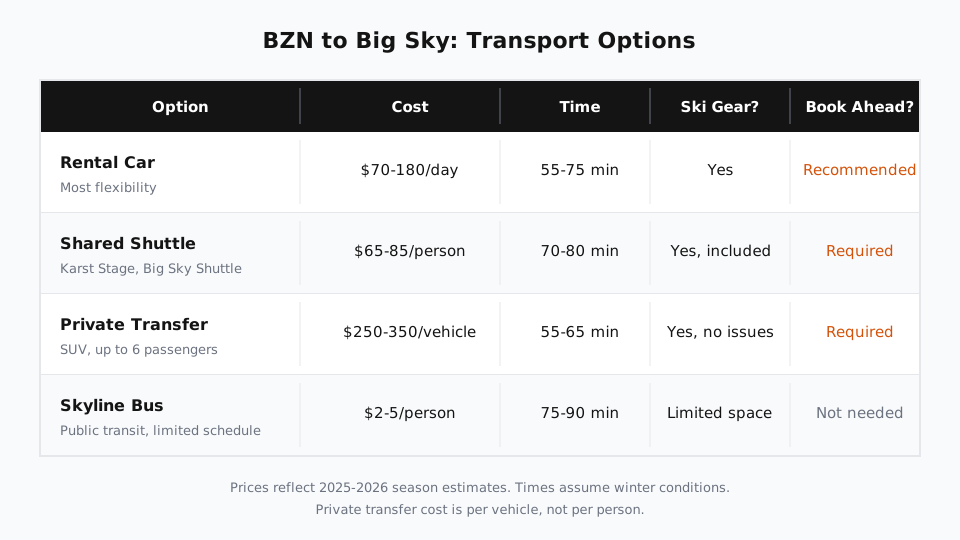
Cost: $70-180/day depending on season and vehicle class, plus gas. Time to Big Sky: 55-75 minutes depending on conditions. Best for: Trips longer than two nights, groups planning to explore, anyone who wants freedom.
Shared shuttles: Karst Stage and Big Sky Shuttle
Two companies dominate the scheduled shuttle market between BZN and Big Sky: Karst Stage and Big Sky Shuttle.
Karst Stage is the longest-running operation. They run scheduled departures timed to common flight arrivals, and you can book a seat on a shared van for about $65-85 per person each way. The vans are clean and the drivers know the canyon road well. They handle ski bags and boot bags at no extra charge, which is a legitimate perk when you’re already juggling gear. In summer, they’ll accommodate bike boxes too, though you should confirm when booking.
Big Sky Shuttle runs a similar model at similar prices. They’ve been slightly more flexible on pickup times in my experience, and they’ll sometimes arrange a departure for a small group that doesn’t line up with the normal schedule. Worth calling to ask.
Both companies will pick you up at the airport and drop you at your lodging in Big Sky. The trip takes about 70-80 minutes because of the additional stops — you’ll wait while they load everyone’s gear, and you may make two or three drop-off stops at different properties in Big Sky.
Here’s the catch: scheduled shuttles run on their schedule, not yours. If your flight is delayed two hours, you’re either waiting for the next shuttle or scrambling for a different option. If your flight lands at 9 PM and the last shuttle left at 8:30, you’re stuck.
Cost: $65-85 per person each way (shared), $200-300 for a private van. Time to Big Sky: 70-80 minutes with stops. Ski gear: Yes, included. Book ahead: Yes, required. At least 48 hours recommended; same-day is unlikely. Best for: Solo travelers, couples going straight to a slopeside hotel, budget-conscious skiers.
Skyline bus: the budget option
The Skyline bus is public transit that runs between Bozeman and Big Sky. It’s extremely affordable — a few dollars each way — and it works fine if your timing lines up. The problem is the schedule was designed for commuters (resort workers, mostly), not tourists arriving on flights. Buses run a few times per day, and the last departure is early evening.
Check the current Skyline schedule against your flight times before counting on it. If your flight lands at 2 PM and there’s a 3 PM Skyline departure from a stop you can get to, it’s a great deal. If not, it’s useless. You also can’t count on it for ski gear. The bus accommodates what fits, and a family of four with ski bags and boot bags is going to have a hard time.
Cost: $2-5 per person each way. Time to Big Sky: 75-90 minutes with all stops. Ski gear: Theoretically, but space is limited. Not reliable for multiple bags. Book ahead: No, just show up. Best for: Flexible travelers on a tight budget who can build their schedule around the bus.
Cost comparison: every option at a glance
Here’s the math for a couple traveling together, one way from BZN to Big Sky:
| Option | Cost per person | Total (2 people) | Travel time | Ski gear? | Book ahead? |
|---|---|---|---|---|---|
| Rental car | $35-90/day + gas | $35-90/day + gas | 55-75 min | Yes | Yes, 2-3 weeks |
| Shared shuttle (Karst/Big Sky) | $65-85 | $130-170 | 70-80 min | Included | 48+ hours |
| Skyline bus | $2-5 | $4-10 | 75-90 min | Limited | No |
| Private transfer | $125-175 | $250-350 total | 55-65 min | Yes | 72+ hours |
| Uber/Lyft | $60-100+ | $120-200+ | 55-75 min | Limited | Not reliable |
For a group of four, the private transfer math changes fast. Split $300 four ways and you’re at $75 per person — about the same as a shared shuttle seat but with no extra stops, no waiting for other passengers, and a guaranteed ride even if your flight is delayed.
Private transfers: the premium option
If convenience matters more than cost, book a private car service. Companies like Montana Executive Transportation and Big Sky Private Car run late-model SUVs (Suburbans, Yukons) and will be waiting at baggage claim with your name on a sign. No waiting for other passengers. No extra stops. Straight to your lodging.
It costs more — $250-350 for a private SUV — but run the math for a ski group. Split $300 four ways and you’re at $75 per person, which is barely more than a shared shuttle. You get a guaranteed ride regardless of flight delays, your own vehicle with room for everyone’s gear, and a driver who can stop if you need to grab groceries in Big Sky Town Center on the way in.
Tip your driver. $20-40 is standard for a private transfer from BZN. They loaded your ski bags in the cold. They waited an extra 30 minutes because your flight was late. Take care of them.
Cost: $250-350 per vehicle (up to 6 passengers). Time to Big Sky: 55-65 minutes, no stops. Ski gear: Yes, no issues. Book ahead: Yes, at least 72 hours recommended. Holiday weeks book out further. Best for: Groups of 3-6, anyone on a tight schedule, families with kids and lots of gear.
Rideshare: Uber and Lyft
I’ll save you some time: don’t plan your trip around a rideshare from BZN. Uber and Lyft technically operate in the Bozeman area, but driver availability at the airport is inconsistent. You might wait 20 minutes. You might open the app and see zero drivers available. Even when a driver accepts, the fare to Big Sky will be $120-200+ because of the distance and the fact that the driver has to make the return trip empty.
Rideshare works in Bozeman proper for getting around town. It does not work as a reliable airport-to-Big-Sky plan.
Timing math: when will you actually arrive?
This is where most people miscalculate. Your flight lands, but you don’t leave the airport immediately. Here’s realistic timing for a winter arrival:
- Deplane and reach baggage claim: 10-15 minutes
- Wait for bags: 10-20 minutes (BZN is fast, but ski bags come out last)
- Rental car counter and vehicle pickup: 15-25 minutes
- Load up, adjust mirrors, set GPS: 5-10 minutes
- Drive to Big Sky: 60-75 minutes in winter conditions
So if your flight lands at 3 PM, you’re arriving at Big Sky around 5:00-5:30 PM. In December, that means you’re driving the last 30 minutes of the canyon in the dark. Not the end of the world, but plan for it. A shuttle eliminates some of the airport faff but adds stop time. A private transfer is the fastest door-to-door option.
For a first visit to Big Sky Resort, I’d plan to land before 2 PM in winter. That gives you a comfortable buffer, arrival in daylight, and time to get settled before dinner.
Winter driving in the canyon
Highway 191 through Gallatin Canyon is a beautiful drive and a serious road. In winter, you’ll encounter packed snow, black ice, narrow shoulders, and the occasional vehicle in the ditch. MDOT plows it regularly, and it’s usually passable, but “passable” and “comfortable” are different things.
AWD helps with acceleration on snow but does nothing for braking or turning. What actually keeps you safe is appropriate tires and appropriate speed. Drive 45 mph when conditions warrant it, even if the speed limit says 60. Leave space. Use your low beams in snow because high beams reflect off the flakes and make visibility worse.
The canyon also has significant cell service dead zones. Download your directions before you leave Bozeman. If you miss the Big Sky turnoff (Highway 64), the next turnaround is a few miles further at the Corral Bar. It’s not a crisis, but it’s annoying when you’re tired and it’s dark.
One more thing: the canyon road runs along the Gallatin River, and wildlife crosses frequently. Elk, deer, and moose are real hazards, especially at dawn and dusk. Don’t drive distracted.
Rent a car vs. shuttle: the decision framework
This isn’t complicated once you ask three questions:
How long is your trip? If you’re staying three nights or more, rent a car. The flexibility is worth the cost, and the daily rate drops on multi-day rentals. If it’s a quick two-night ski weekend and you’re going straight to a slopeside hotel, a shuttle works fine.
Will you leave the resort? If your plan includes a day in Bozeman, a Yellowstone day trip, or dinner at restaurants outside the base area, you need a car. Big Sky’s free local shuttle covers the resort area, but it doesn’t get you back to town or anywhere else interesting.
How big is your group? Solo or a couple: shared shuttle is the best value. Three or four people: a private transfer costs about the same per person as a shuttle and is far better. Five or six: rent a full-size SUV and split the total cost.
Tipping etiquette
Shuttle drivers and private car drivers depend on tips. Here’s what’s standard:
- Shared shuttle: $5-10 per person, more if the driver helps with heavy gear.
- Private transfer: $20-40 total for the vehicle, more for large groups or difficult conditions.
- Skyline bus: No tipping expected (it’s public transit).
Cash is easiest. Some booking systems let you add a tip when you pay online, but the driver might not see that for weeks. Hand them cash and say thanks.
Book ahead for everything
Bozeman is a small airport in a rural state. The “I’ll figure it out when I land” approach that works in Denver or Salt Lake does not work here. Rental cars sell out. Shuttle seats fill up. Private transfers book weeks in advance during holidays. Whatever option you pick, have it confirmed before you board your flight to Bozeman. Your trip starts the moment you land, and the last thing you want is to be standing at baggage claim scrolling through options on your phone while the sun goes down.
More in logistics
Buying a Montana Fishing License: Costs, Rules, and Logistics for Nonresidents
By Bozeman Proper Staff
Where to Go for Urgent Care, Pharmacies, and Medical Help in Bozeman & Big Sky
By Bozeman Proper Staff
Bozeman airport security wait times and how early to arrive
By Bozeman Proper Staff
Where to park in downtown Bozeman (free lots, the garage, and what not to do)
By Bozeman Proper Staff